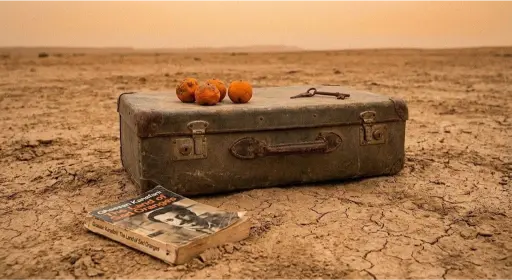
NASIONALISME.NET, Tangsel — The Land of Sad Oranges is a short story written by Palestinian author Ghassan Kanafani. Published in 1962, this anthology depicts profound literature about the Palestinian Nakba and the trauma of exile. The story follows the perspective of a Palestinian family as they and their relatives are dispossessed and forced to leave their homeland after the 1948 Palestinian War. This story powerfully depicts the trauma of exile, focusing on Kanafani’s portrayal of displacement not only as a physical condition, but as the erosion of identity, hope, and humanity. The oranges in the story symbolize the loss of homeland and the degree to which what once symbolized life becomes a symbol of sadness. This essay will analyze how Ghassan Kanafani’s The Land of Sad Oranges reflects the characteristics of postcolonial literature through its portrayal of exile, loss of identity, and psychological trauma, as well as how these themes relate to the theories of Frantz Fanon, Edward Said and Ilan Pappé.
Kanafani in this story reflects the essence of postcolonial literature that highlights exile, displacement, and resistance to Western and Zionist colonialism. Through the eyes of a child, he describes a family leaving Jaffa for Lebanon, a journey that highlights the loss of childhood innocence due to colonial violence, such as the loss of home, history, and a sense of belonging. When the narrator says, “Beloved Acre was already disappearing behind the bends in the road” (Kanafani, 1962, p. 75). The reader can feel that exile is not only about geographical distance but also spiritual loss. This image symbolizes the loss of homeland and identity that cannot be restored. Refugees are depicted as “swallowed by the road,” a metaphor for how colonialism devours human life and history. In addition, the change in the symbolism of the orange, which was once a symbol of Palestinian fertility and prosperity, has now become a symbol of sadness and cultural displacement, as mentioned in “The orange as dried up and shriveled” (Kanafani, 1962, p. 80). The decay of the orange reflects the destruction of Palestinian identity under colonial domination. Kanafani’s symbolism reflects postcolonial criticism of how colonialism destroys both material conditions and psychological identity.
In this literary work, Kanafani aims to reveal the political and humanistic dimensions of the destruction of Palestinian life and to preserve the collective memory of the experience of exile. As a writer who also lived in exile, Kanafani used literature as a form of resistance against colonial domination, giving voice to those silenced by the colonizers’ narrative, especially refugees who lost not only their homeland, but also their sense of belonging and identity. Kanafani’s depiction of his father’s psychological destruction — “Your father fell silent… we saw him lying on the ground, gasping for breath and grinding his teeth as he wept” (Kanafani, 1962, p. 79), shows how exile cripples male pride and dignity, in line with Frantz Fanon’s view that colonialism dehumanizes the body and soul. Furthermore, the use of a child’s perspective reinforces the tragic aspect of this story, in which the child’s awareness that “As I left the house behind, I left childhood behind too” (Kanafani, 1962, p. 80) marks a forced maturity due to colonial violence. Through realism and minimalism, Kanafani conveys deep suffering without having to display excessive emotion, making his work a powerful testimony to trauma and resistance.
This literary work is related to Edward Said’s concept of Orientalism and Ilan Pappé’s work The Ethnic Cleansing of Palestine. Edward Said’s concept of Orientalism explains how the Western world has shaped the image of the East as inferior and voiceless. Kanafani’s story challenges this view by portraying Palestinian refugees as complex human beings, not as “the other.” This story restores humanity to the victims of colonial expansion by recounting their own experiences. In The Politics of Dispossession, Said emphasizes that the Palestinian experience is defined by “peripherality, isolation, and silence all of those are conditions of displacement and loss” (Said, 1994, p. 51). Kanafani’s narrative directly embodies this idea the displacement of refugees from Jaffa to Sidon symbolizes the erasure of their historical and cultural continuity. By writing this story, Kanafani resists colonial attempts to erase Palestinian memory. Meanwhile, Ilan Pappé’s work The Ethnic Cleansing of Palestine frames the mass expulsion of Palestinians as a systematic colonial project. The scene in The Land of Sad Oranges when “The men began handing their weapons to the policeman stationed there for the purpose” ((Kanafani, 1962, p. 79) emphasizes the powerlessness of the Palestinian people in the face of organized expulsion. Kanafani’s fiction is thus in line with Pappé’s historical documentation that exile was a deliberate colonial act, not merely a consequence of the chaos of war.
In conclusion, Ghassan Kanafani’s The Land of Sad Oranges reveals exile as both physical displacement and psychological destruction. Through the symbolism of the orange, he portrays how colonialism corrodes identity and memory. The story humanizes Palestinians and resists the Orientalist image of “the voiceless other,” as discussed by Edward Said. In line with Ilan Pappé’s idea of systematic expulsion, Kanafani’s narrative preserves the collective memory of loss. Ultimately, his work stands as a literary resistance that reclaims voice, identity, and the right to remember.
Daftar Pustaka
- Kanafani, G. (1962). The Land of Sad Oranges. In Palestine’s Children: Returning to Haifa and Other Stories. (B. Harlow, Trans.). Lynne Rienner Publishers.
- Fanon, F. (1963). The wretched of the earth (C. Farrington, Trans.). Grove Press. https://mronline.org/wp-content/uploads/2020/10/Frantz-Fanon-The-Wretched-of-the-Earth-1965.pdf
- Said, E. W. (1978). Orientalism. Pantheon Books. https://archive.org/details/orientalism0000said/page/n2/mode/1up
- Said, E. W. (1994). The politics of dispossession: The struggle for Palestinian self-determination, 1969-1994. Pantheon Books. https://www.rahs-open-lid.com/wp-content/uploads/2024/01/Said-Edward-W.-The-Politics-of-Dispossession_-The-Struggle-for-Palestinian-Self-Determination-1969-1994-Vintage-2012.pdf
- Pappé, I. (2006). The ethnic cleansing of Palestine. Oneworld Publications. https://www.simonandschuster.com/books/The-Ethnic-Cleansing-of-Palestine/Ilan-Pappe/9781851685554
Written by Neni Nuraeni