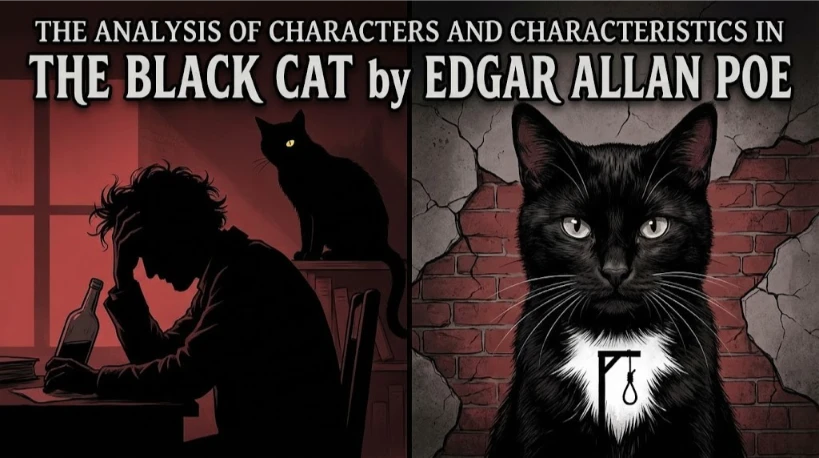
NASIONALISME.NET, Tangsel — The Black Cat was first published on August 19, 1843, in The Saturday Evening Post. This short story is one of Edgar Allan Poe’s most well-known works of psychological horror, exploring themes of guilt, madness, and moral degeneration. In this essay, the writer presents a brief synopsis of the story and analyzes its characters and characterization, which are essential narrative elements in prose fiction.
The story is narrated by an unnamed man who recounts his life with deep regret, particularly the transformation of his personality. Initially portrayed as a kind and affectionate individual, the narrator gradually descends into cruelty and moral corruption after becoming obsessed with alcohol and his black cat, Pluto. His alcoholism leads him to commit a series of violent acts, including the murder of animals and ultimately his own wife. However, his crimes are eventually exposed when a second black cat, marked with white fur, reveals the location of his wife’s hidden body. Through this tragic sequence, Poe explores themes of guilt, madness, and moral degeneration.
The main characters in the story are the narrator and the narrator’s wife. The narrator explicitly acknowledges the drastic change in his personality, which becomes the foundation of his criminal behavior. This transformation is clearly illustrated in the following passage,
“During which my general temperament and character… experienced a radical alteration for the worse. I grew, day by day, more moody, more irritable, more regardless of the feelings of others. I suffered myself to use intemperate language to my wife…But my disease grew upon me for what disease is like Alcohol!… even Pluto began to experience the effects of my ill temper.” (Poe, 1843, page. 2).
This quotation demonstrates the narrator’s radical shift in character. Once gentle and loving toward his wife and pets, he becomes increasingly gloomy, irritable, and indifferent to the feelings of others. His abusive behavior toward his wife marks the deterioration of his moral values. The narrator himself attributes this change to alcohol, which he describes as a “disease,” emphasizing its destructive influence on his personality.
As the story progresses, the narrator’s emotional instability intensifies, culminating in an act of extreme violence. This moment is revealed when his suppressed rage finally erupts,
“But this blow was arrested by the hand of my wife, Goaded, by the interference, into a rage more than demoniacal, I withdrew my arm from her grasp and buried the axe in her brain. She fell dead upon the spot, without a groan.” (Poe, 1843, page 5, page 6).
This passage illustrates the narrator’s loss of self-control and moral reasoning. His anger escalates rapidly, and his inability to manage his emotions leads him to murder his own wife without hesitation. The narrator exhibits traits associated with severe psychological disturbance, including impulsivity, aggression, and disregard for social norms and human life. Poe uses this character to demonstrate how unchecked emotions and addiction can transform a human being into a monster.
In contrast, the narrator’s wife is portrayed as a gentle and supportive figure. Her character is introduced early in the story, emphasizing her compatibility with the narrator and her kindness toward animals,
“I married early, and was happy to find in my wife a disposition not uncongenial with my own. Observing my partiality for domestic pets, she lost no opportunity of procuring those of the most agreeable kind.” (Poe, 1843, page.2).
This quotation highlights the wife’s caring nature and her role as a stabilizing presence in the narrator’s life. She shares his love for animals and consistently supports his interests. Tragically, her compassion and attempts to intervene only provoke the narrator’s violent tendencies, ultimately leading to her death.
In conclusion, The Black Cat presents a terrifying exploration of guilt, madness, and the consequences of moral decay. Through the characterization of the narrator and his wife, Edgar Allan Poe demonstrates his mastery of psychological horror and his deep understanding of the darker aspects of human nature. The story serves as a cautionary tale about the destructive power of addiction and uncontrolled emotion.
References:
- Poe, E. A. (1843). The black cat. The Saturday Evening Post.
- Hidayat, M. I., & Nafisah, N. (2020). Trauma in Edgar Allan Poe’s The Black Cat. Jurnal PSG, 8, Article 22921. https://ejournal.upi.edu/index.php/psg/article/view/22921
- Karlina, A. (2007). The psychological problems of main character in The Black Cat by Edgar Allan Poe (Undergraduate thesis). Universitas Islam Negeri Syarif Hidayatullah Jakarta. https://repository.uinjkt.ac.id/dspace/handle/123456789/10331
Written by Neni Nuraeni